
What's an EFT payment? And when should I use one?
Understanding the benefits, pros and cons, and processes behind the increasingly popular transaction type.

How EFT payments work
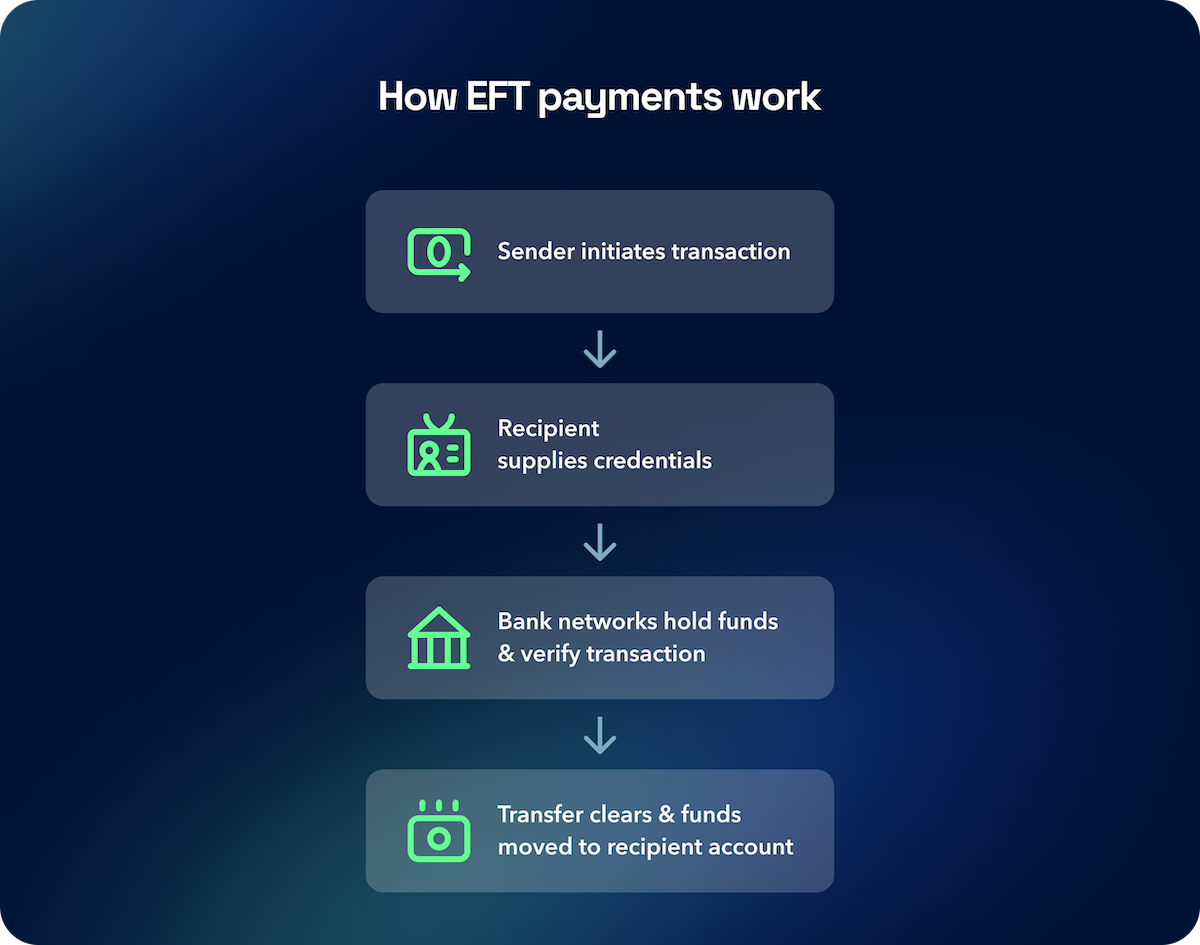
EFT processing happens mostly behind the scenes. Here is what happens when a payment is initiated:
- Initiation: The sender provides the recipient's bank account and routing number and authorizes the transfer. In some cases, such as a pre-authorized debit (PAD) agreement, the recipient initiates the pull.
- Verification: The sender's financial institution confirms that the funds are available and that the payment has been properly authorized.
- Settlement: The sender's bank contacts the recipient's bank with transaction details and initiates the fund transfer through the relevant payment network.
- Crediting: The recipient's bank credits the funds to the correct account and may send a confirmation to the recipient.
The specific path a payment takes depends on the type. ACH transfers go through the ACH network operated by Nacha and are typically processed in batches. Wire transfers move through networks like Fedwire or SWIFT, settling on a transaction-by-transaction basis. Card payments route through Visa, Mastercard, or another card network, with a payment processor handling authorization and settlement.
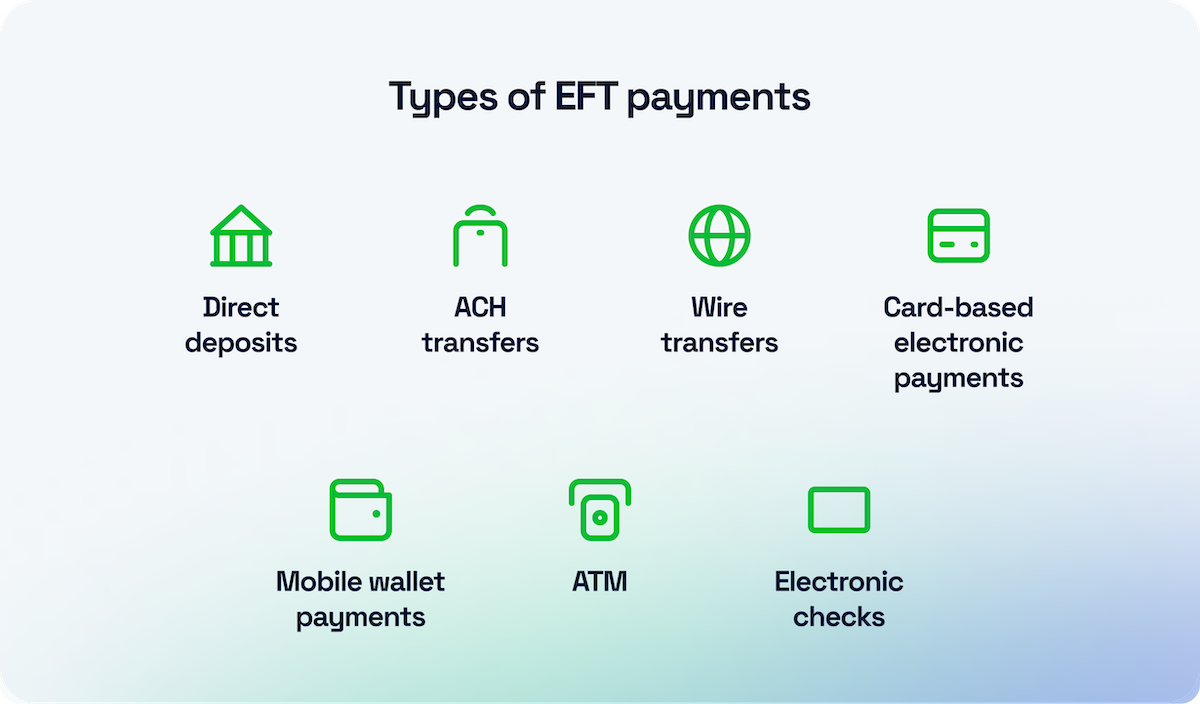
7 common types of EFT payments
Electronic checks (eChecks)
Electronic checks, or eChecks, are the digital equivalent of paper checks. They use bank account and routing numbers to transfer funds electronically. For businesses, accepting check payments online through eCheck removes the need to wait for physical mail or make trips to deposit paper checks , while preserving compatibility with vendors who still expect check-based payment processes.
Direct deposit
A direct deposit is an EFT in which funds, typically payroll, are deposited automatically into a recipient's bank account on a recurring schedule. Employers use direct deposit through the ACH network to eliminate paper checks, reduce administrative overhead, and ensure employees receive their pay reliably and on time.
ATM withdrawals
ATM transactions are a form of EFT that allow customers to access funds or make deposits outside of banking hours. The transaction deducts from the account holder's balance in real time or near real time through the card network.
Credit and debit card transactions
Card payments are processed through card networks like Visa and Mastercard. The network authorizes the transaction, the payment processor facilitates fund movement, and the amount is either charged to a credit line or debited directly from the payer's bank account. Virtual cards and chip technology have made card-based EFT one of the more secure payment methods available.
Internet and mobile payments
Online banking portals and mobile payment apps have expanded EFT to peer-to-peer transfers, mobile wallets, and online bill payments. These transactions use the same underlying bank infrastructure as traditional EFT but are initiated through consumer-facing interfaces rather than bank branches.
Phone payments
Some businesses and utilities still accept payment by phone using interactive voice response (IVR) systems. Less common than they once were, phone payments remain an accessibility option for customers without internet access.
Wire transfers
Wire transfers send funds directly between banks, typically in large amounts and within the same business day. They are commonly used for B2B payments, real estate transactions, and cross-border transfers. The trade-off is cost: domestic wire transfers typically run $15 to $35 per transaction, and international wires can cost $40 to $50 or more, plus currency conversion fees. For recurring high-volume B2B payments, how long a wire transfer takes and what it costs are often the deciding factors in whether wire is the right tool.
EFT vs ACH: what is the difference?
ACH and EFT are related but not the same thing. ACH (Automated Clearing House) is a specific payment network and a specific type of EFT. Every ACH transfer is technically an EFT, but not every EFT is an ACH transfer. The main difference between the two is geography. The ACH national network facilitates transfers between U.S. financial institutions, including banks and credit unions, but not international entities.
ACH payments are processed in batches through the Nacha network, typically overnight, with standard transfers settling in 1 to 3 business days. Same-day ACH is available but carries higher fees. ACH is the backbone of payroll direct deposit, vendor payments, and recurring billing in North America.
|
Comparing |
EFT |
ACH |
|
Scope |
Broad umbrella term |
Specific payment network and method |
|
Speed |
Varies by type (seconds to days) |
1 to 3 business days (same-day option available) |
|
Cost |
Varies by type |
Low, typically $0.20 to $1.50 per transaction |
|
Best for |
Any electronic payment |
Recurring B2B payments, payroll, vendor bills |
|
Processing |
By type (card network, SWIFT, ACH, etc.) |
Batch processing via Nacha network |
EFT vs wire transfer: speed vs cost
Wire transfers and ACH are both types of EFT, but they serve different purposes. The core tradeoff is speed versus cost.
Wire transfers settle the same day (if submitted before the bank's cutoff window) and are final: once sent, they cannot be reversed. That finality makes them the preferred method for large, time-sensitive transactions like real estate closings, M&A payments, and significant B2B transactions.
ACH is slower but far cheaper and reversible. For businesses managing high volumes of recurring payments, ACH delivers the better unit economics.
|
Comparing |
Wire transfer |
ACH |
|
Speed |
Same day |
1 to 3 business days |
|
Reversibility |
Not reversible |
Reversible within window |
|
Domestic cost |
$15 to $35 |
$0.20 to $1.50 |
|
International cost |
$40 to $50+ |
Limited availability |
|
Best for |
Large, time-sensitive, one-time transfers |
Recurring, high-volume, lower-value payments |
For businesses sending international business payments, Plooto offers cross-border EFT at flat-rate pricing that is materially lower than traditional wire fees, one of its most significant differentiators for Canadian businesses managing USD/CAD transactions. See Plooto's international business payments feature for how it works in practice.
EFT vs check: why the transition is overdue
Paper checks are technically not EFT: they are physical instruments that require manual handling, mailing, and physical deposit. eChecks bridge the gap by digitizing the same bank account and routing number information into an electronic format that processes like ACH.
The comparison is stark. The hidden cost of check payments includes postage, printing, reconciliation time, float, and the risk of checks being lost or delayed in transit. EFT eliminates most of these friction points.
|
Comparison Factor |
Paper check |
EFT (eCheck/ACH) |
|
Processing time |
3 to 5 business days after receipt |
1 to 3 business days |
|
Cost per payment |
$4 to $20 (fully loaded) |
$0.20 to $1.50 |
|
Fraud risk |
High (check washing, forgery) |
Lower with proper controls |
|
Reconciliation |
Manual |
Automated with accounting software |
|
Vendor compatibility |
Universal |
Near-universal with eCheck option |
For businesses still managing check-dependent workflows, transitioning from checks to electronic payments does not require forcing every vendor to change immediately. Platforms like Plooto allow businesses to send and receive payments in the method each party prefers while managing everything from a single dashboard.
Pros and cons of EFT payments
Pros & Benefits of EFT
- Speed: Electronic payments reach the recipient faster than physical checks, with some methods (card, wire) settling in near real time.
- Lower cost: ACH and eCheck transactions cost a fraction of wire transfer fees and eliminate the fully-loaded cost of paper check processing.
- Convenience: EFT can be initiated at any time from any device. Neither party needs to be physically present.
- Automation: Recurring EFT payments can be fully automated through platforms like Plooto's accounts payable automation and accounts receivable automation, reducing manual entry and the errors that come with it.
- Audit trail: Every EFT transaction generates a digital record that supports reconciliation and compliance.
Cons & Risks to EFT
- Technology dependency: EFT requires functional systems on both ends. A network outage or POS failure can temporarily disrupt payment acceptance.
- Fraud risk: EFT is not immune to fraud. Phishing, unauthorized ACH pulls, and account takeover attacks are real threats. However, security practices and platform controls significantly reduce exposure.
- Processing time on some methods: ACH in particular is not instant. Businesses that need same-day finality must use wire transfers or real-time payment networks, which cost more.
EFT security and regulations
EFT payments in the United States are governed by the Electronic Fund Transfer Act (EFTA), implemented through the CFPB's Regulation E. Regulation E gives consumers the right to dispute unauthorized transactions, limits liability for reported fraud, and requires financial institutions to investigate and resolve errors within defined timeframes. The Federal Trade Commission provides consumer guidance on EFT rights and how to respond to unauthorized transactions.
For B2B transactions, the rules differ. Most Regulation E protections apply to consumer accounts, not business accounts. This is why businesses need their own controls built into their payment platforms.
Nacha governs the ACH network and sets rules for authorization, return codes, and fraud prevention. Nacha's rules require that ACH debits be authorized by the account holder before funds are pulled, which is the basis for pre-authorized debit (PAD) agreements widely used in Canada and ACH authorization agreements in the U.S.
For cross-border payments, ISO 20022 is the international standard for payment messaging, and SWIFT handles the messaging infrastructure for international wire transfers. The Clearing House's RTP network enables real-time payments in the U.S. with final settlement in seconds, an emerging alternative to next-day ACH for time-sensitive B2B transactions.
How to set up EFT payments for your business
Setting up EFT payments involves a few consistent steps regardless of which method you use:
- Choose your payment method: Decide whether ACH, eCheck, wire, or a combination best fits your payment volume, timing needs, and cost tolerance.
- Select a payment platform: Your bank may offer basic ACH payment functionality, but dedicated platforms like Plooto add approval workflows, accounting software integration, multi-entity management, and automated reconciliation that banks do not natively provide.
- Collect banking details: You will need the recipient's bank account number and routing number for ACH and eCheck payments, or their SWIFT/IBAN details for international wire transfers.
- Set up authorization: For recurring payments, get written authorization from the payee (a PAD agreement for Canadian EFT, or ACH authorization for U.S. payments). Plooto automates the PAD agreement process, sending it directly to the contact for signature.
- Integrate with accounting software: Connecting your payment platform to QuickBooks or Xero means every EFT automatically reconciles, with no manual entry required after the fact.
- Run a test transaction: Before rolling out to all vendors or clients, confirm that a small test payment routes correctly and reconciles as expected.
For businesses managing payments to and from multiple clients, look for solutions for accountants and bookkeepers built specifically for multi-client EFT management in a single platform. Here’s a well-known example: Small businesses and finance teams handling their own payments can use Plooto's EFT tools without enterprise-level complexity. Plooto's EFT payment landing page walks through specific setup steps for Canadian and U.S. businesses.
How EFT payments help businesses
EFT is not just about moving money electronically. For businesses, the real value is in what automation and consolidation make possible downstream.
- Cash flow visibility: When every payment runs through a single platform, finance teams can see exactly what is outstanding, what has cleared, and what is scheduled. That visibility feeds directly into working capital planning and cash flow forecasting. Plooto's online payment software is built around this principle.
- Vendor and client relationships: Faster, more predictable payments reduce friction with suppliers and improve days payable outstanding (DPO) management. On the receivables side, offering EFT to clients removes barriers to on-time payment.
- Compliance and audit readiness: Every EFT generates a time-stamped digital record. For businesses with audit obligations, that trail exists automatically rather than requiring manual documentation.
- International reach: For businesses with cross-border supplier or client relationships, international payment solutions built on EFT infrastructure make global payment management practical without requiring a separate banking relationship in every country. See Plooto's guide to everything about online payments for how the different payment methods fit together in a modern finops stack.
A practical example: The Influence Agency, a digital marketing firm, adopted Plooto's EFT automation to replace manual check processing and manage international payments. The result was more than $1,000 per month saved in transaction fees, plus the elimination of manual reconciliation time that had previously consumed significant finance team hours. Their experience reflects a pattern seen across businesses that map out their finops stack thoughtfully: the right EFT infrastructure compounds its value over time.
EFT is the foundation of modern business payments
Every business that pays vendors, receives client payments, runs payroll, or manages cross-border transactions is already using EFT. The question is not whether to use electronic funds transfers. The real question is how efficiently you are managing them.
Manual EFT workflows, fragmented across banking portals and spreadsheets, leave money on the table through errors, delays, and missed payment discounts. Automated EFT workflows, run through a unified platform, give finance teams control, visibility, and time back.
Plooto sits between your accounting software and your bank, handling EFT payment execution, approval workflows, and automatic reconciliation in one place, so your team spends less time processing payments and more time on work that moves the business forward.
Frequently asked questions
What does EFT stand for? EFT stands for electronic funds transfer. It refers to any transfer of money between bank accounts initiated electronically.
What is an EFT payment example? Common examples include payroll direct deposit, ACH bill payments, wire transfers for large purchases, eCheck payments to vendors, and debit card transactions. Any payment that moves money electronically from one bank account to another is an EFT.
How long does an EFT payment take? It depends on the method. Card transactions settle in seconds. Same-day ACH settles the same business day. Standard ACH takes 1 to 3 business days. Wire transfers settle the same business day if submitted before the bank's cutoff. Cross-border wires can take 2 to 5 business days.
Is EFT the same as ACH? No. ACH is a specific type of EFT that runs through the Automated Clearing House network. EFT is the broader category. All ACH payments are EFT, but not all EFT payments are ACH.
Is EFT safe? Yes, with appropriate controls. EFT transactions are protected by Regulation E (for consumer accounts), Nacha's operating rules, and the security infrastructure of the banks and payment platforms involved. Businesses should use platforms with approval workflows, dual authorization for large payments, and clear audit trails to minimize fraud exposure.
What is the difference between an EFT and a wire transfer? Both are types of EFT, but wire transfers move money faster (same day) and at higher cost ($15 to $50+), with no reversibility. ACH (another EFT type) is slower (1 to 3 business days) and cheaper ($0.20 to $1.50), but can be reversed within a window.
How do I receive EFT payments? Provide the sender with your bank account and routing number (for ACH/eCheck) or IBAN/SWIFT details (for international wire). Alternatively, platforms like Plooto allow you to send payment requests to clients, who complete the transfer through a secure payment link without requiring you to share banking credentials directly.
What is EFT in banking for businesses? In a business context, EFT refers to the electronic payment infrastructure used for accounts payable, accounts receivable, payroll, and vendor management. Businesses use EFT to automate recurring payments, reduce manual processing, and maintain payment audit trails. Understanding the 7 key financial terms SMB owners need (EFT among them) is foundational to managing business finances effectively.
Table of contents
 What's an EFT payment?
How EFTs work
The different types of EFTs
EFT vs. ACH payments
Pros & cons of EFTs
What's an EFT payment?
How EFTs work
The different types of EFTs
EFT vs. ACH payments
Pros & cons of EFTs
Sign up in minutes.
Start saving hours.
Manage all of your payments in one platform. No jumping between apps necessary.
Start free trial